
The Esade Admission Test Study Guide
Four sections in 185 minutes, 85 of them English; a deduction for every wrong answer in the other three; no calculator and no paper; one attempt per academic year. Every question type and every rule, in one free 96-page PDF.
- Every question type as Esade's sample tests lay it out: text and statements, business problems, data sufficiency, missing-operand arithmetic, figure series, the essay and the gap-fills
- Negative marking as arithmetic: where answering breaks even at -0.25 and at -0.50, why no English item is left blank, and the assumption behind the numbers
- A diagnostic in five timed blocks (39 questions for business programmes, 33 for Law), with solutions and a map from each miss to its chapter
- The clock, section by section, with checkpoints to hold in your head since no paper is allowed; and the set-up that keeps the one attempt valid
Free. We email you the download link, and it works for seven days.
- Pages
- 96
- Version
- 1.0.1
- Published
- 21 September 2026
- Facts verified
- 21 September 2026
- Cycle
- 2027/28 admissions
- Price
- Free
Real pages from the guide
Four of the 96 pages, exactly as they appear in the PDF.
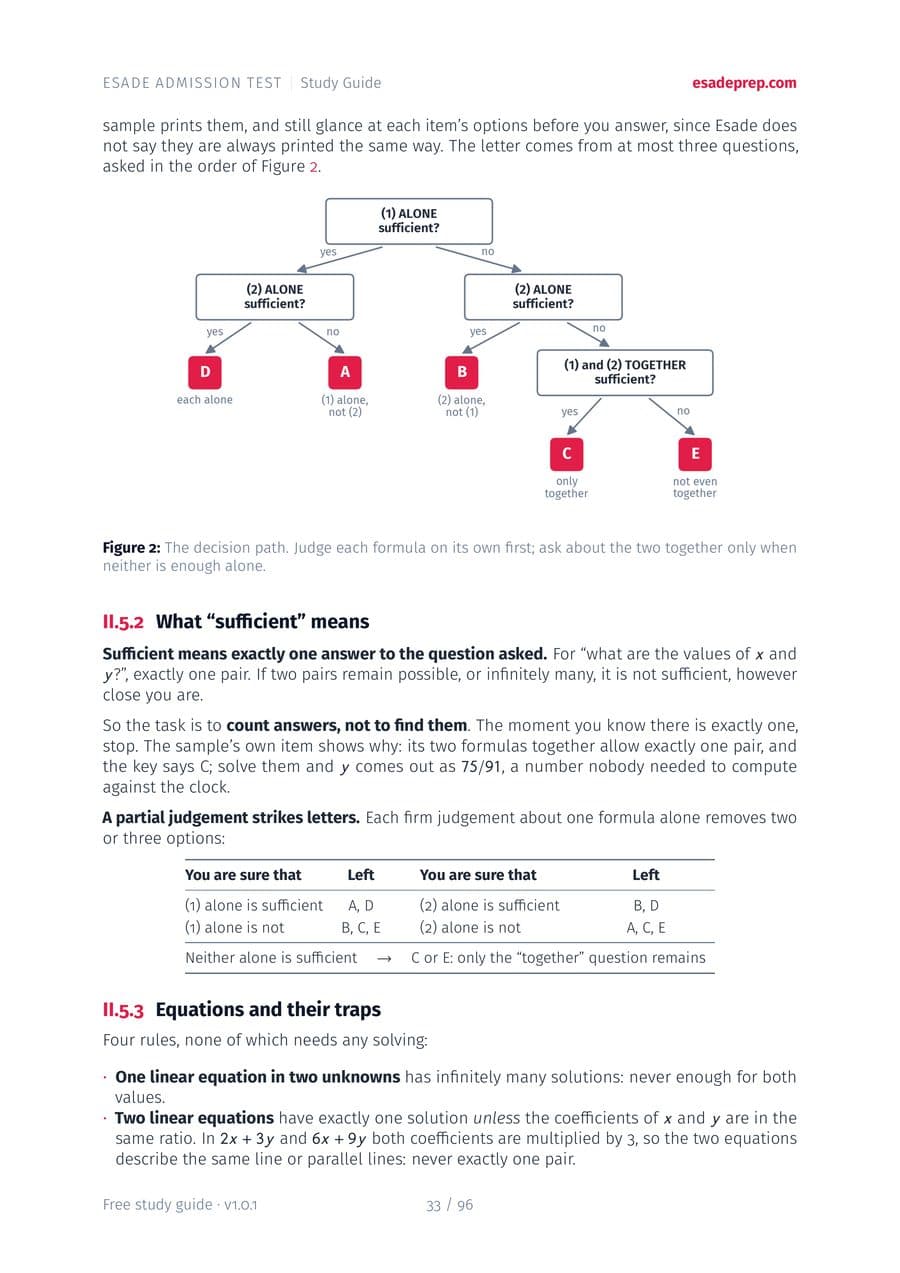
Sufficiency of information: the data-sufficiency decision path, and what "sufficient" means 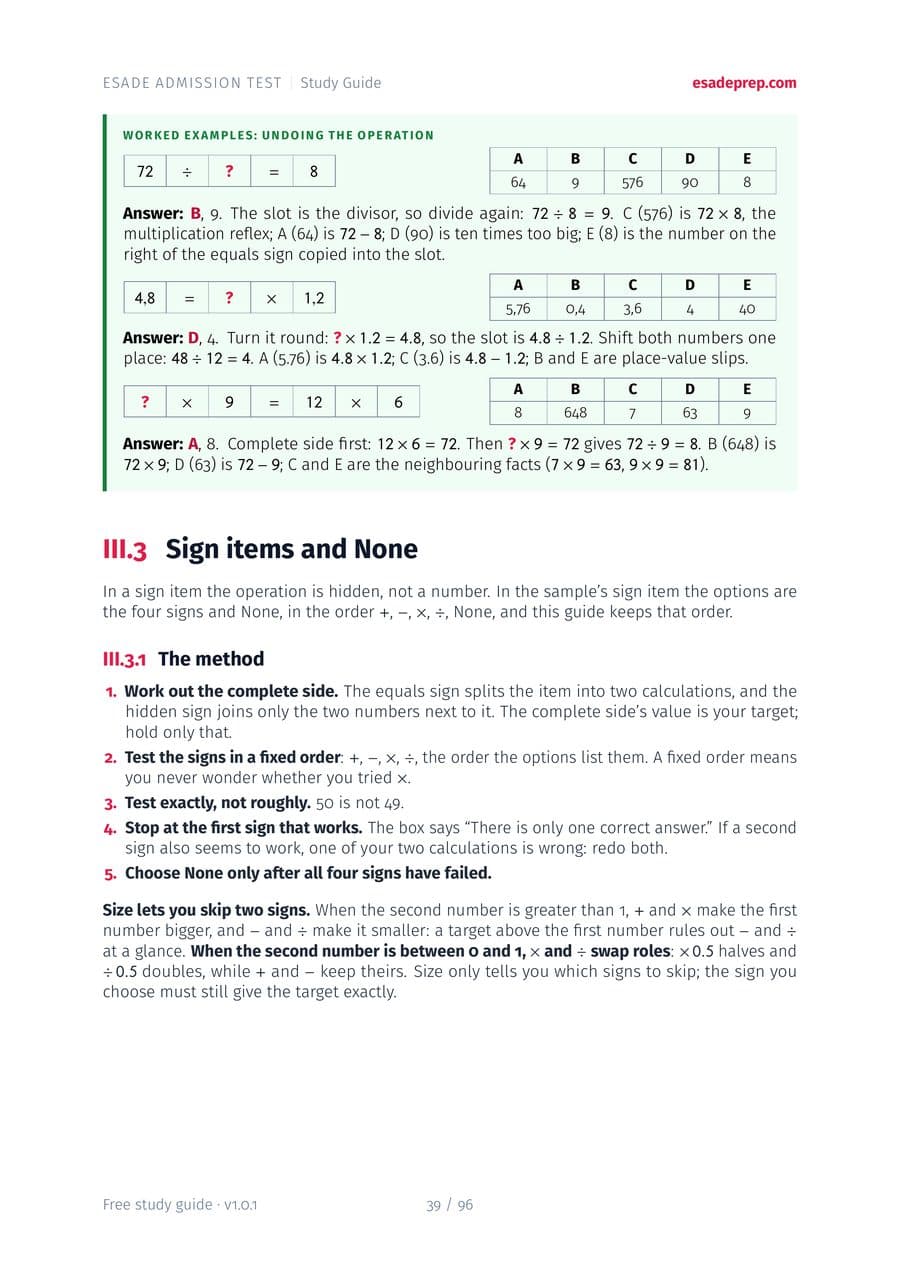
Numerical analysis: undoing the operation, worked item by item, then sign items and None 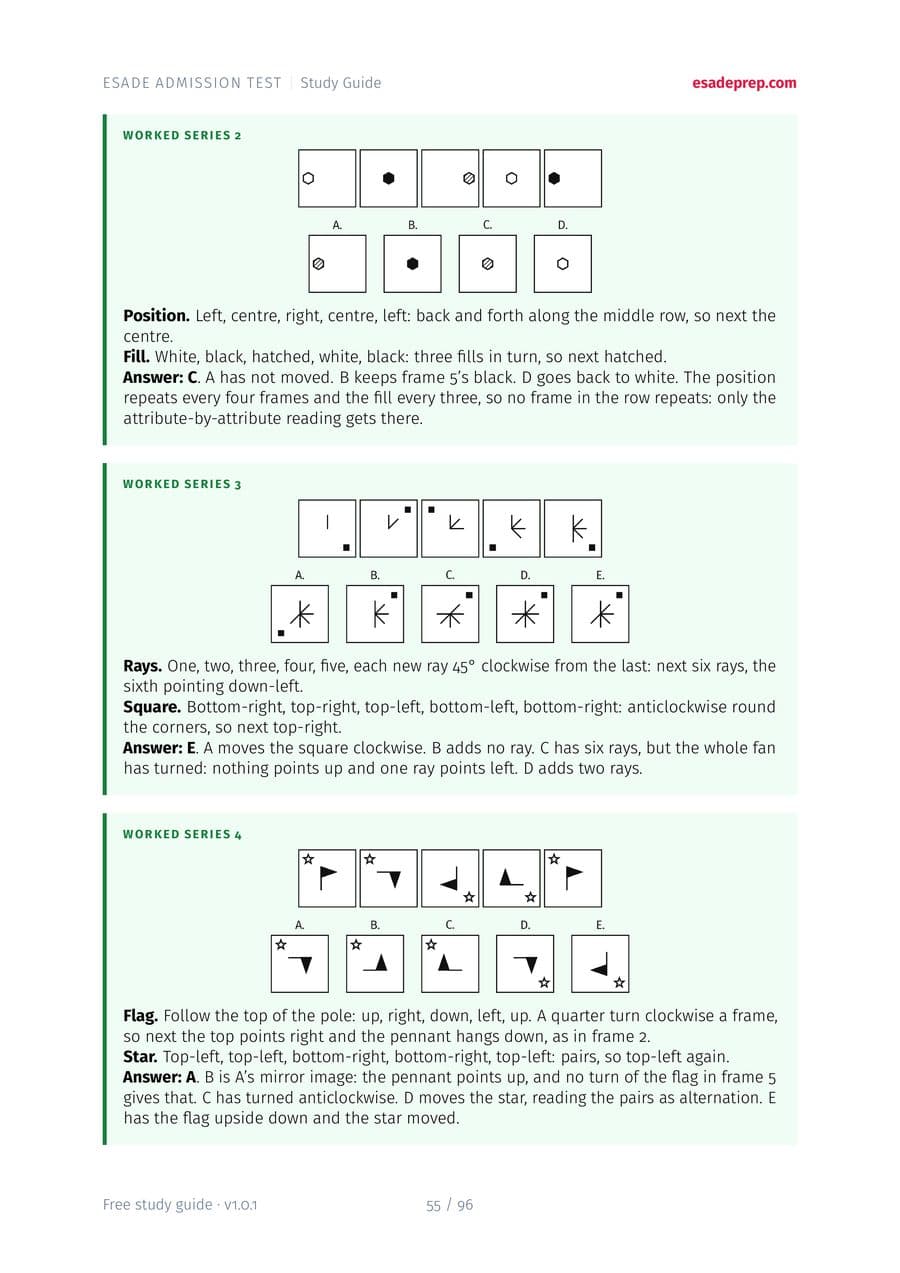
Logical reasoning: figure series worked one attribute at a time 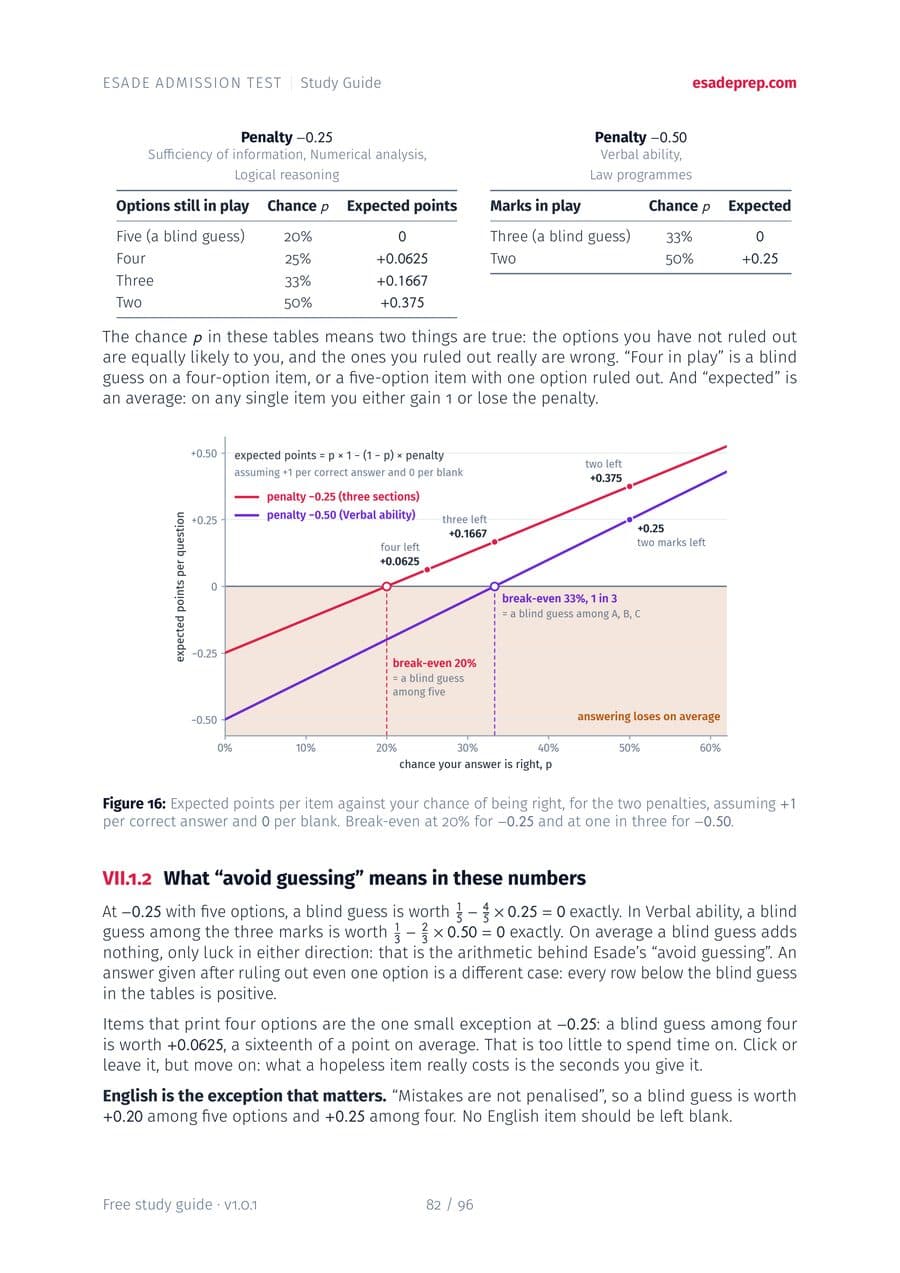
Strategy: negative marking as arithmetic, with the break-even for each penalty
Nine parts, 96 pages, one test
The guide is written for Esade's bachelor programmes: the seven that sit Numerical analysis and the two Law programmes that sit Verbal ability instead, with a part for each. Esade publishes no syllabus for the test; what it publishes is a sample test per programme, and every part shows each question type the way the samples lay it out. Esade also says the test cannot be studied for as a subject, and the guide agrees with it in print: it promises no score, only that nothing on the day is new to you. Every worked example, passage, figure series and diagnostic question was written for it: nothing is taken from Esade's sample tests or from another publisher.
- Before you start
How the test works
The test in one page (and the master's test that shares its name), which section your programme sits, what the test decides and what it does not, applying, booking and the one attempt per academic year, the rules on the day that decide whether your attempt counts, what practice can and cannot do in Esade's own words, plans for three weeks, one week and three days, and the questions parents and applicants ask.
- Part I
Diagnostic
Five short timed blocks, one for each section of the test: 39 questions for business programmes, 33 for Law, each question type of Esade's sample tests once, under the section's own penalty. Full solutions with a one-line reason, and a map from each miss to the chapter that covers it.
- Part II
Sufficiency of information
The three shapes the section takes: a text followed by statements (what "can be deduced" means, the Roman-numeral items and the author's position), business problems worked without paper, and data sufficiency with its five fixed answers. Then pacing the sixteen questions.
- Part III
Numerical analysis
One operation with a question mark in a slot, 48 times in 35 minutes: every slot and its inverse, sign items and None, the facts to have ready (times tables, squares, halves and doubles, fractions and decimals), shortcuts, the checks that rule options out, pacing, and three drill sets of 16 with answers.
- Part IV
Logical reasoning
Figure series: a method that reads one attribute at a time, a catalogue of rules (movement, rotation, back and forth, alternation, counting, elements appearing and disappearing), two rules at once, six worked series, the traps, ten practice series with answers, and pacing.
- Part V
Verbal ability (Law programmes)
The section the two Law programmes sit instead of Numerical analysis, from Esade's Spanish sample: the three marks (true, false, not enough information) and why the third is the hard one, a method for each statement, two passages worked in full, the -0.50 penalty and the clock, and a practice passage.
- Part VI
English level test
The 25-minute essay (a plan, linking words, a four-minute error check, a model essay, spellings to be sure of), then 100 gap-fills in 60 minutes: a method, a grammar reference, false friends and transfer errors for Spanish, Catalan and Italian speakers, and practice items with answers.
- Part VII
Strategy and test day
Negative marking as arithmetic: the break-even for each penalty, what "avoid guessing" means in numbers, and the rule by section; pacing the 185 minutes with checkpoints; choosing your slot; setting up the computer, the phone and the room; during the test; and after it, with no score to work out and no second attempt this year.
- Part VIII
Sheets, checklist and glossary
Three reference sheets (arithmetic, reasoning, English) opening on the penalties and the clock for every section, a test-day checklist to print, a glossary of the sample tests' wording in Spanish, and the sources every fact in the guide comes from.
Verified, and dated
Every fact about the test (sections, minutes, penalties, the rules on the day, how admission works) was checked against Esade's official bachelor admissions pages and the sample tests it publishes for its business and Law programmes, on 21 September 2026.
Versioned
This is version 1.0.1 (21 September 2026). The version is on the cover and in every footer, so you always know which edition you are holding. Spotted an error? Write to contact@esadeprep.com.
No dates in the PDF
Esade admits on a rolling basis and publishes no test calendar: you choose your own slot once your application is complete. A PDF cannot update itself, so the guide prints no date. Read the current process, and the sample test for your programme, on Esade's own admissions-test page, and check again before you pay the application fee. EsadePrep is independent and not affiliated with or endorsed by Esade or Universitat Ramon Llull.
Get ready for ESADE
Comprehensive preparation for the 2026/27 ESADE Admission Test
Single-Subject Prep
Target one area: Verbal, Numerical or Logical Reasoning
All-Subject Prep
Practice all three areas of the ESADE Admission Test
All-Subject + Crash Course
Online two-day crash course with Q&A plus practice of all three areas
Everything in our All-Subject Prep plus....